Auto Paint Correction in San Diego: Restore & Protect Your Vehicle
Auto Paint Correction in San Diego: Restore & Protect Your Vehicle
TL;DR:
- Paint correction permanently removes surface defects, restoring vehicle finish and gloss.
- Professionals use multi-stage processes, precise measurement, and tailored techniques for safe results.
- Post-correction protection like ceramic coatings extends longevity in San Diego’s harsh environment.
Many San Diego vehicle owners assume auto paint correction is just a fancier version of a standard polish or wax job. It isn’t. Paint correction is a technical, multi-stage process that physically removes defects from your vehicle’s clear coat rather than masking them. Unlike wax, which fills scratches temporarily, correction actually eliminates the source of the problem. That distinction matters enormously, especially in a climate like San Diego’s, where intense UV exposure, marine air, and dry heat accelerate paint degradation year-round. This guide walks you through what paint correction truly involves, how professionals approach it, what to look for in a local specialist, and how to protect your results long after the work is done.
Table of Contents
- What is auto paint correction and why does it matter?
- Understanding the paint correction process: Stages and methods
- How to choose a paint correction specialist in San Diego
- After paint correction: Long-term protection and care
- The real value of professional paint correction: What most guides miss
- Get expert paint correction and protection in San Diego
- Frequently asked questions
Key Takeaways
| Point | Details |
|---|---|
| True correction removes defects | Auto paint correction physically removes scratches and swirls, not just hides them like wax. |
| Expert diagnosis is essential | A professional evaluates your paint’s condition before recommending one-step or multi-stage correction. |
| Local providers differ by technique | Always verify a San Diego provider’s methodology and experience, not just their reviews. |
| Protection extends results | Adding ceramic coating and proper maintenance is critical for lasting shine in the San Diego climate. |
What is auto paint correction and why does it matter?
Auto paint correction is the process of removing surface defects from a vehicle’s clear coat, the transparent protective layer that sits on top of your base color. Swirl marks, light scratches, water spot etching, oxidation, and buffer trails all live in this layer. Correction uses abrasive compounds and polishing compounds, applied with machine polishers, to carefully level the surface and restore optical clarity.
This is not the same as waxing or applying a paint sealant. Those products sit on top of the surface and fill in imperfections temporarily. When they wear off, the defects return. Correction removes clear coat material to permanently eliminate the defect, rather than hiding it beneath a product layer. That’s a fundamental difference in both technique and outcome.
Here’s why this matters for your vehicle:
- Restored gloss and depth: Swirl marks scatter light and make paint look dull. Correction eliminates that scatter, restoring the deep, mirror-like finish your paint had when the vehicle was new.
- Improved protection: A smooth, corrected surface bonds more effectively with ceramic coatings and paint protection film, maximizing their performance.
- Preserved resale value: Vehicles with well-maintained, defect-free paint command higher resale prices. Buyers and appraisers notice paint quality immediately.
- Eliminated oxidation: In San Diego’s sunny climate, oxidation, which is the chalky, faded appearance caused by UV breakdown of the clear coat, is a common problem. Correction removes oxidized material and restores color vibrancy.
“Paint correction is not a cosmetic shortcut. It is a precise, material-removing process that demands expert knowledge of paint systems, abrasive chemistry, and machine technique.”
One of the most persistent misconceptions is that any detailer with a buffer can deliver true paint correction. In reality, improper technique causes more damage than it fixes. Using the wrong pad, compound, or speed setting can generate heat that burns through the clear coat or creates new swirl marks. This is why the paint correction process must be handled by trained professionals who understand paint systems and use the right tools for each specific vehicle.
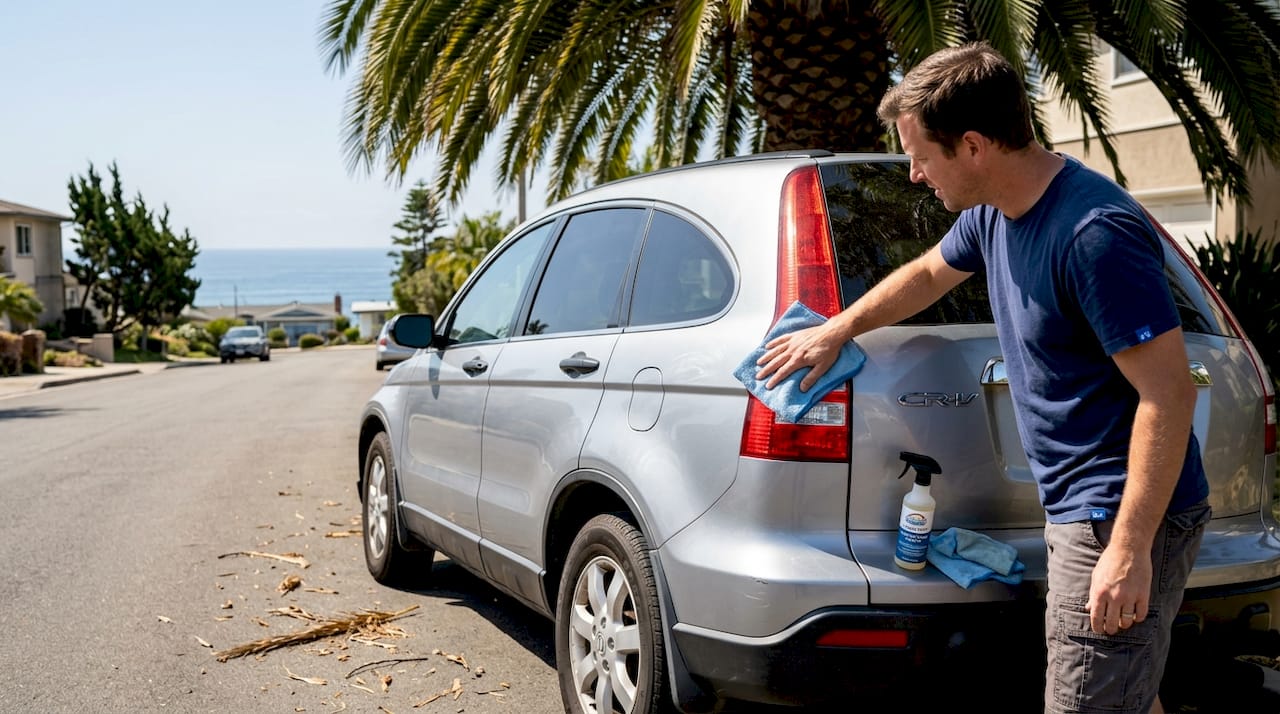
San Diego’s environment adds urgency to this. The combination of intense UV radiation, salty coastal air, and dry Santa Ana wind conditions creates a particularly harsh environment for vehicle paint. Oxidation, water spotting from sprinklers, and bird dropping etching are routine problems here. Addressing them with proper correction, rather than a quick polish that wears off in weeks, gives your vehicle lasting results and a stronger foundation for protective coatings.
Understanding the paint correction process: Stages and methods
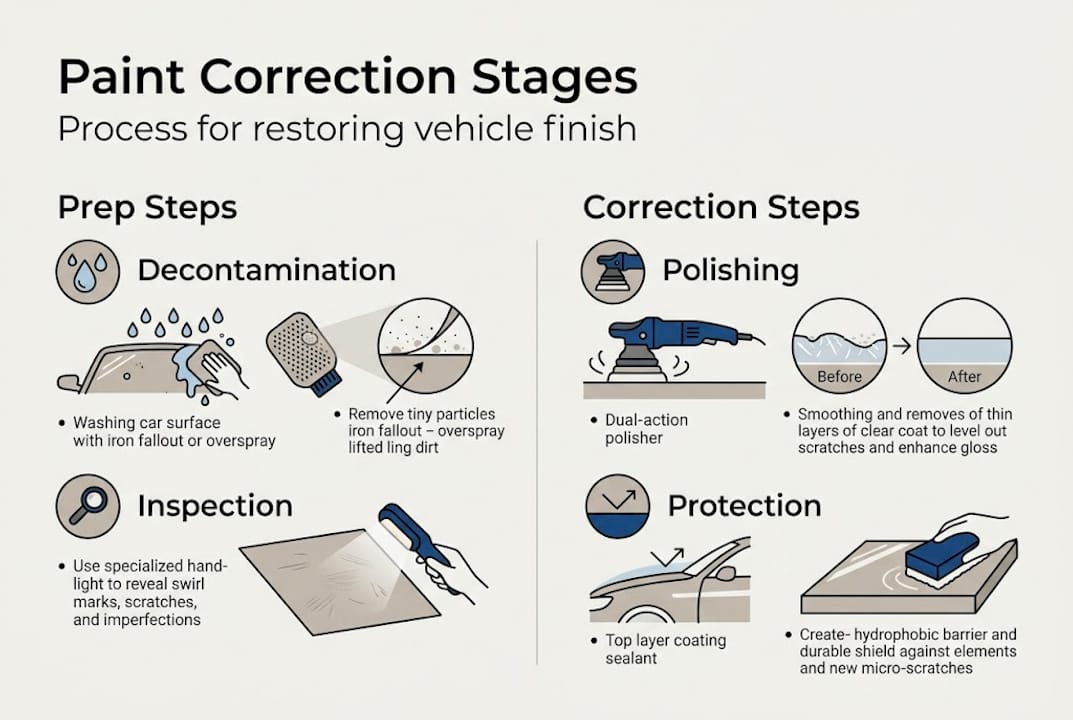
Professional paint correction follows a structured sequence. Skipping steps or rushing through them is where most errors occur. Here’s how a properly executed correction unfolds:
- Thorough decontamination: The vehicle is washed, clayed, and chemically decontaminated to remove embedded iron particles, tar, and other bonded contaminants. Polishing over contamination causes scratching.
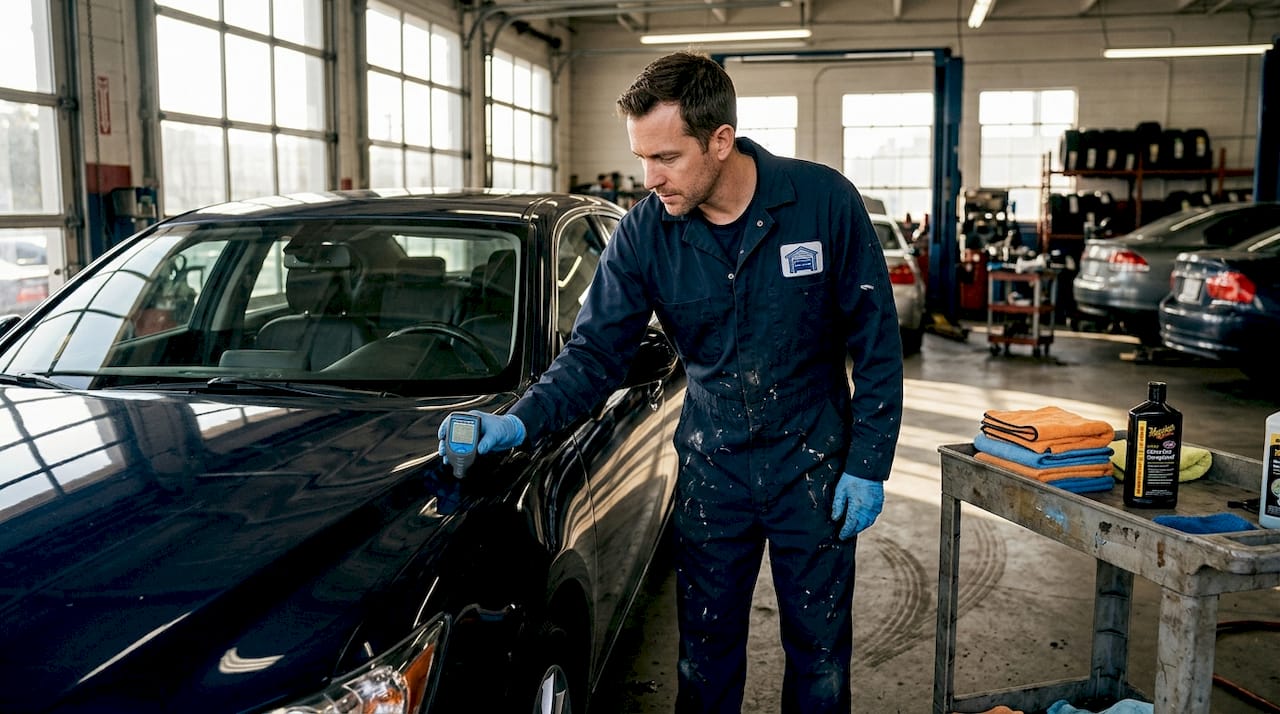
- Paint thickness measurement: A paint thickness gauge is used to measure clear coat depth across multiple panels. This tells the technician how much material is safely available for removal.
- Defect assessment under specialized lighting: Swirl marks, scratches, and oxidation are evaluated under LED and halogen lighting to map the severity and distribution of defects.
- Test spot correction: Before committing to the full vehicle, a small test area is corrected to confirm the chosen pad and compound combination delivers the intended result without over-cutting.
- Compounding stage (if needed): Heavy defects require a cutting compound paired with a foam or microfiber cutting pad. This removes the most material and addresses deeper imperfections.
- Polishing stage: A finer polish and softer pad refine the surface, removing any light marring left by the compounding stage and maximizing gloss.
- Final inspection and panel wipe-down: Panels are wiped with an isopropyl alcohol solution to remove polish oils and reveal the true corrected finish under lighting.
Pro Tip: Ask your detailer to show you the paint thickness readings before and after correction. A reputable specialist will have this data and will share it willingly. It’s your paint, and you deserve to know how much clear coat remains.
One-step correction uses a single product to cut and polish simultaneously. It’s faster and suits vehicles with light defects or thin clear coats where removing more material would be risky. Multi-stage approaches use separate compounding and polishing steps for heavier defects, delivering a more thorough result. The right choice depends entirely on your paint’s condition, not on a standard menu package.
| Stage | Purpose | Material removed | Result |
|---|---|---|---|
| Decontamination | Remove surface bonded particles | None | Clean base for correction |
| Compounding | Eliminate heavy scratches and oxidation | Moderate to high | Defects removed, some marring |
| Polishing | Refine surface after compounding | Low | High gloss, no marring |
| One-step correction | Light defect removal and finishing | Low to moderate | Improved gloss, minor defects removed |
As tailored methods confirm, there is no single recipe for paint correction. Every vehicle presents a different paint system, defect profile, and clear coat thickness. A professional who diagnoses before they polish will always deliver better, safer results than one who applies the same process to every car.
How to choose a paint correction specialist in San Diego
Understanding the process makes it much easier to evaluate who should perform it. Not every detailer offering paint correction in San Diego is equipped to do it correctly. Here’s what to look for.
Key questions to ask before booking:
- Do you measure paint thickness before starting correction?
- Will you perform a test spot before committing to the full vehicle?
- How do you determine whether one-step or multi-stage correction is appropriate?
- Can you show me before and after photos of vehicles similar to mine in color and paint type?
- Are your technicians trained and certified in paint correction techniques?
If a provider can’t answer these questions confidently, that’s a clear signal to look elsewhere.
Comparison of provider types in San Diego:
| Provider type | Pros | Cons |
|—|—|—|
| Chain detailing shop | Convenient locations, standardized pricing | Limited customization, high technician turnover |
| Independent shop | Experienced specialists, personalized service | Fixed location, may require drop-off |
| Mobile detailing service | Comes to your home or office, flexible scheduling | Varies widely in quality, vet carefully |
| Dealership detail department | Convenient with service appointments | Often uses one-size-fits-all packages |
When reading reviews, go beyond star ratings. Local provider reviews can be useful for volume, but look specifically for mentions of paint thickness measurement, multi-stage processes, and technician communication. Generic five-star reviews that only mention “great shine” don’t confirm technical competence.
Pro Tip: Request before and after photos specifically for dark-colored vehicles if yours is dark. Swirl marks are most visible on black, dark gray, and navy paint. If a provider can show flawless results on those colors, they know what they’re doing.
For guidance on choosing local detailers in San Diego, focus on specialists who communicate their process clearly and treat diagnosis as a non-negotiable first step. When you’re ready to move forward, booking a paint correction with a provider who offers transparent methodology is the most important decision you’ll make for your vehicle’s finish. Look for a detailed paint correction service that includes pre-inspection, documentation, and aftercare guidance as standard.
After paint correction: Long-term protection and care
Paint correction restores your vehicle’s finish to its best possible condition. What you do in the weeks and months after determines how long that condition lasts. In San Diego’s sun-intensive environment, protection and maintenance after correction are not optional steps. They are essential.
Ceramic coating: The most effective post-correction protection
A ceramic coating is a liquid polymer that bonds chemically to your vehicle’s clear coat. Once cured, it creates a hard, hydrophobic (water-repelling) layer that protects against UV rays, environmental contaminants, bird droppings, water spots, and light marring. Applying a ceramic coating immediately after paint correction locks in the corrected surface and prevents new defects from forming as quickly.
The ceramic coating longevity you can expect in San Diego depends on the product grade and your maintenance habits, but professional-grade coatings typically last two to five years with proper care. That’s years of protection built on top of a freshly corrected, flawless surface.
Post-correction care essentials:
- Use a pH-neutral car shampoo: Harsh detergents strip protective coatings and accelerate surface degradation. A pH-neutral shampoo cleans effectively without damaging the coating.
- Wash with a soft microfiber wash mitt: Sponges and rough cloths introduce swirl marks. A quality microfiber mitt lifts dirt away from the surface rather than dragging it across.
- Dry with a touchless air blower or clean microfiber drying towel: Dragging a damp chamois across a corrected surface creates micro-marring. Air drying or patting dry with a plush microfiber towel prevents this.
- Avoid automatic car washes with brushes: Brush-style automatic washes are one of the leading causes of swirl marks on corrected paint.
- Apply a ceramic coating maintenance spray: Every few months, a spray booster refreshes the hydrophobic properties of your coating and extends its life.
- Park in shade or a garage when possible: San Diego’s UV intensity is significant. Consistent sun exposure accelerates oxidation even on coated vehicles.
Pro Tip: Schedule a paint inspection every six to twelve months with your detailer. Catching early signs of contamination or coating wear before they become defects is far less expensive than a full correction later.
For ongoing guidance on caring for corrected paint, work with a provider who offers maintenance programs. Consistent, informed care is what separates vehicles that stay showroom-quality for years from those that need correction again within eighteen months.
The real value of professional paint correction: What most guides miss
Most articles on paint correction focus on what the process does. Few talk about what separates a great outcome from a damaging one. Here’s our honest perspective after working on hundreds of vehicles in San Diego.
The single most important trait in a paint correction specialist is restraint. Aggressive correction isn’t always better. We’ve seen vehicles come to us after over-correction at other shops, where the clear coat was thinned so severely that it couldn’t hold a ceramic coating properly and began failing within a year. The technician removed every visible defect, but at the cost of the paint’s long-term integrity.
True expertise means knowing when not to correct. A professional who measures your paint thickness, evaluates the defect depth, and tells you honestly that a one-step polish is all your clear coat can safely handle is protecting your investment. One who defaults to aggressive multi-stage correction on every vehicle, because it looks more impressive, is not.
We also believe that a great specialist educates you during the process. You should leave understanding what was found, what was done, and what your paint needs going forward. That transparency is what builds trust and what makes the service genuinely valuable rather than just cosmetically satisfying.
When evaluating providers, look for the ones who talk about diagnosis first. The best practices for paint correction always begin with assessment, not action. That mindset is what protects your clear coat and your money.
Get expert paint correction and protection in San Diego
If you’re ready to restore your vehicle’s finish the right way, Severin Detailing brings professional-grade paint correction directly to your home or office across San Diego County. Our mobile service eliminates the hassle of drop-offs and waiting rooms while delivering meticulous, diagnosis-first correction that protects your clear coat and maximizes your results.

Our paint correction services include pre-inspection, paint thickness measurement, test spot evaluation, and tailored stage selection based on your vehicle’s specific needs. We also offer ceramic coating application immediately after correction to lock in your results and provide long-term protection against San Diego’s UV and environmental conditions. Membership options are available for ongoing maintenance and protection. When you’re ready to take the next step, book a detail today and receive a prompt appointment confirmation. Your vehicle deserves more than a quick polish.
Frequently asked questions
How long does auto paint correction last in San Diego conditions?
With proper maintenance and ceramic coating protection, correction results can last several years even in San Diego’s intense sun, provided you follow a consistent washing and care routine.
Can paint correction remove all scratches and defects?
Paint correction safely eliminates most surface-level swirl marks and defects, but deep scratches penetrating the base coat or primer layer may require repainting rather than polishing to fully resolve.
Is paint correction safe for all types of paint finishes?
With proper diagnosis and technique tailored to your vehicle’s specific paint system, correction is safe for most modern clear-coat finishes, though soft or thin clear coats require extra care and restraint.
Does paint correction remove the clear coat?
Yes, every correction removes a small amount of clear coat material, which is why pre-correction paint thickness measurement and expert restraint are critical to preserving long-term finish integrity.
Can I do paint correction myself, or should I use a professional?
Mild polishing is possible for experienced DIYers, but professional correction ensures diagnosis, material management, and technique precision that protects your paint and delivers results that last.